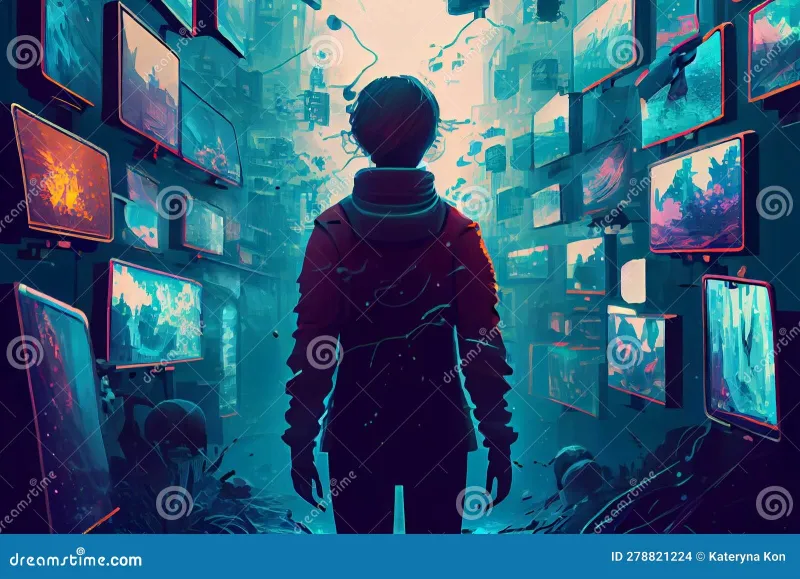
Ghost Frequency: The Very Real Grief of Losing a Creator You Never Met
Photo: W.carter, CC BY-SA 4.0, via Wikimedia Commons
There's a particular kind of silence that hits different when a YouTube channel you've watched for six years suddenly stops uploading. Not the silence of a bad week or a vague "taking a break" Instagram story. The permanent kind. The kind where you check back three months later, then six, and the last video just sits there like a gravestone you weren't invited to visit.
You didn't know this person. You've never been in the same room. You couldn't pick their voice out of a lineup if it weren't attached to a thumbnail. And yet — something in you genuinely mourns.
Welcome to the ghost frequency. The channel between real connection and projected intimacy that millions of Americans are quietly tuned into right now.
The Illusion of Closeness (And Why It's Not Really an Illusion)
Parasocial relationships — the one-sided emotional bonds audiences form with media figures — aren't new. Psychologists Donald Horton and Richard Wohl described the phenomenon back in 1956, back when people were writing fan letters to TV hosts they'd never meet. What's new is the texture of it.
Today's content creators don't just appear on a screen twice a week. They document their morning routines. They cry on camera. They share their apartments, their breakups, their therapy breakthroughs. The intimacy feels mutual because the format mimics it so well — direct eye contact through a lens, confessional tone, the casual "you guys" that makes a million viewers feel addressed personally.
"What we're seeing isn't delusional," says Dr. Pamela Rutledge, a media psychologist who has studied parasocial dynamics for over two decades. "The emotional responses are real. The neurological pathways activated are the same ones activated by real friendships. The brain doesn't have a separate filing system for 'people I've met' and 'people I watch online.'"
So when a creator disappears — or worse, changes — the brain processes it like any other relational rupture. Grief, confusion, a low-grade anger you feel weird about having.
The Breakup That Wasn't
Ask around in the right corners of the internet and you'll find accounts that read like actual relationship post-mortems.
A 24-year-old in Chicago described watching her favorite beauty creator pivot from honest, low-budget tutorials to obvious brand deals and hollow positivity content. "It was like she became someone else," she said. "I know that sounds dramatic. But I'd watched her for four years. I felt like I knew her, and then one day I didn't recognize her anymore."
A 31-year-old in Austin talked about the gaming streamer who'd been part of his nightly wind-down routine for three years before abruptly retiring from content creation. "He posted a goodbye video and I couldn't watch it for like two weeks. I kept clicking away. I think I was avoiding it the same way you avoid reading a breakup text."
These aren't isolated experiences. They're a pattern. And the emotional vocabulary people use — betrayal, abandonment, grief — maps almost perfectly onto the language of personal loss.
When the Signal Changes Frequency
There's a particular cruelty in the pivot — the version of creator loss where the person doesn't disappear but transforms into something unrecognizable. It's arguably harder to process than a clean departure because there's no closure. The channel still exists. The uploads still come. But the thing that connected you to it has quietly left the building.
This version tends to generate the most confused grief, because the audience can't fully justify their own feelings. The creator is still there. You just don't recognize them anymore.
Dr. Crystal Abidin, a researcher who studies influencer culture and audience dynamics, has noted that this "drift" often triggers what she describes as a retroactive questioning of the entire relationship — fans going back through old content trying to figure out when exactly things changed, or whether the person they loved was ever really "real" in the first place.
It's a disorienting spiral. And it tends to play out very publicly in comment sections that function less like feedback and more like group therapy.
The Community That Grieves Together
One thing that distinguishes parasocial grief from ordinary loss is how communal it becomes. When a creator steps away, entire subreddits go into something resembling collective mourning. Fan Discord servers slow to a crawl. Tribute edits circulate on TikTok. There's a shared processing that happens in real time, which is simultaneously comforting and strange — thousands of people grieving someone none of them personally knew, together.
This communal dimension can be genuinely healing. It validates feelings that might otherwise seem embarrassing. It creates space to say "I know this is weird but I'm actually kind of devastated" and have that met with recognition instead of ridicule.
But it can also tip into something less healthy — the collective denial phase, where communities keep a creator's memory alive through archival projects and tribute content in ways that start to feel less like celebration and more like refusing to let go.
Tuning Out Without Shutting Down
So what do you do with it? How do you process a loss that the rest of the world doesn't fully recognize as one?
Most researchers point to the same basic answer: you treat it like a real loss, because neurologically, it is one. You let yourself be bummed out without catastrophizing it. You acknowledge the connection was real even if it was asymmetrical. And you resist the urge to either dismiss your own feelings as embarrassing or amplify them into something that starts affecting your daily life.
The grief is proportionate when it passes. When a creator's absence starts functioning like a genuine void — when you can't fill the space they left, when you find yourself unable to engage with similar content, when the loss starts shaping your mood weeks or months later — that's when it's worth sitting with a little more intentionally.
Because the frequency was real. The signal was real. What you built around it — the routine, the comfort, the sense of being accompanied through your day by someone who felt like a friend — that was real too.
The fact that it only ever transmitted in one direction doesn't mean it didn't reach you.