Crossed Frequencies: The Moment a Superfan Becomes Something Darker
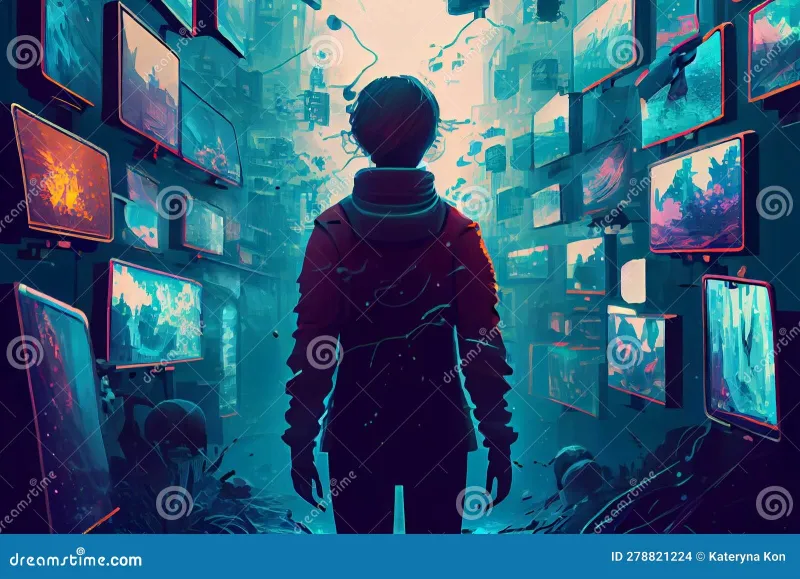
Photo: shadowy figure watching glowing screen social media obsession, via thumbs.dreamstime.com
There's a version of fandom that feels like warmth. You follow someone for years, you know their cadence, their sense of humor, the way they pause before a punchline. You feel seen when they describe something you've also felt. That's the good static — the kind that connects.
And then there's the other kind.
Somewhere in the noise, a different signal starts to bleed through. Fans who don't just watch — they monitor. Supporters who don't just engage — they possess. The line between community and obsession isn't always a dramatic cliff. Sometimes it's a slow, barely visible slope, and by the time anyone notices, someone's already at the bottom of it.
The Architecture of False Intimacy
Psychologists have a phrase for the one-sided emotional bond people form with media personalities: parasocial relationship. It's not inherently bad. Feeling connected to a podcaster or a YouTube creator is, for most people, a low-stakes emotional experience — something like having a favorite author. You feel like you know them. You don't. That gap is where things get strange.
Dr. Pamela Rutledge, a media psychologist who has written extensively on parasocial dynamics, describes the problem as one of perceived reciprocity. When a creator speaks directly to camera, responds to comments, or shares personal stories, the brain processes that intimacy as mutual. It isn't. But the emotional circuitry doesn't always care about the distinction.
For most fans, that gap is easy to hold. For others — particularly those who are socially isolated, dealing with attachment issues, or simply spending an unsustainable number of hours consuming one creator's content — the gap starts to feel like a personal injustice. They gave so much. Why won't the creator give back?
When the Signal Gets Hostile
Talk to enough content creators and a specific kind of story starts to repeat itself, each version slightly more unnerving than the last.
A mid-sized lifestyle creator based in Austin — who asked to remain anonymous — described the moment she realized something was wrong. A fan had been commenting on her videos for two years, always supportive, always present. Then she posted a video with a friend. Within 48 hours, the friend had been identified, their social media scraped, and a thread on a fan forum had speculated extensively about whether the friendship was "replacing" the fans.
"It wasn't threatening, exactly," she said. "It was more like... surveillance. The feeling that someone was taking notes."
That surveillance escalates. Creators have reported fans cross-referencing background details in videos to identify their home neighborhoods. Some have had their family members tracked down and contacted. Others have had private Discord servers infiltrated by fans posing as casual followers, only to screenshot and redistribute conversations the creator intended for a small, trusted community.
Doxxing — the publication of someone's private information without consent — has become a tool in the arsenal of the most extreme fans. And the motivation isn't always malice in the traditional sense. Sometimes it's a twisted form of intimacy-seeking. If I know where you live, I know you're real. If I can find you, you can't disappear on me.
Ordinary People, Extraordinary Harm
Here's the part that gets uncomfortable: most of the people who engage in this behavior aren't what true crime has trained us to picture. They're not isolated figures in dark rooms with walls covered in printouts. They're people with jobs and friends and social media profiles. They participate in fan communities that, by most measures, look pretty normal.
Dr. Jodi Klugman-Rabb, a clinical psychologist specializing in behavioral compulsion, notes that the community structure of fandom can actually enable escalation rather than check it. "When a group collectively validates extreme behavior — when doxxing a creator's ex-partner gets upvoted in a forum — it normalizes the act for individuals who might otherwise feel the discomfort of crossing a line," she explained. "The group absorbs the moral weight."
This is the parasocial uncanny valley: the space where something that looked like community suddenly reveals itself as something else. The features are almost right. The warmth is almost genuine. But something in the movement is off, and once you see it, you can't unsee it.
The Asymmetry Nobody Talks About
What makes this dynamic particularly corrosive is the power asymmetry. Creators — especially independent ones without label deals, studio backing, or security teams — are largely on their own when things escalate. Platforms have been notoriously slow to act. Harassment policies exist but enforcement is inconsistent. And the same visibility that built a creator's career makes them easy to find.
A musician from Chicago who runs a moderately successful Bandcamp and Patreon described going private on all platforms for three months after a fan began contacting her bandmates, her venue bookers, and eventually her parents. "The weirdest part," she said, "is that this person genuinely believed they were a supporter. They left me a message saying they were hurt that I'd blocked them. Like I'd done something to them."
That inversion — where the creator's attempt to protect themselves becomes reframed as a betrayal — is a hallmark of the most destabilizing fan behavior. The relationship was never real, but the feelings driving it were. And feelings that feel real demand to be honored, even when the object of them never consented to the role.
Retuning the Signal
None of this means fandom is broken. Communities built around shared appreciation for art, music, film, and creators can be genuinely life-giving. The warmth is real. The connections people form with each other inside those communities are real.
But the architecture of modern content platforms — built to maximize engagement, to encourage parasocial bonds because they drive watch time and subscriptions — doesn't come with a circuit breaker. It rewards the feeling of closeness without any mechanism to distinguish healthy attachment from something that's starting to corrode.
Creators are increasingly building those circuit breakers themselves: moderating more aggressively, creating tiered communities with slower onboarding, being deliberately less personal in their public content. Some have described it as a kind of grief — pulling back from the openness that made their work feel special in order to stay safe.
The static is still there. It's just that some of it was never warmth to begin with. Learning to tell the difference, for both creators and the fans who genuinely love their work, might be the most important skill nobody's teaching.